Advantages of laser eye surgery is that you can see clearly just 24 hours after a procedure that takes only 15-30 minutes per eye. This revolutionary treatment is changing lives all over the UK. Your trip from blurry to brilliant vision happens quicker than you’d expect, and the results speak for themselves – over 95% of patients achieve 20/20 vision or better.
The quick recovery time is just the beginning. Laser eye treatment gives you lasting freedom from glasses and contact lenses. Patients feel more confident, and this newfound confidence shows up in every part of their lives. The financial picture makes sense, too. The one-time cost of laser eye surgery is nowhere near what you’ll spend on glasses and contact lenses over your lifetime. This piece walks you through everything that makes this procedure so popular today. You’ll find details about minimal downtime and long-term savings. The different types of procedures and cutting-edge technology will give a safe and precise outcome for qualified candidates.

What is laser eye surgery, and how does it work?
Laser eye surgery permanently changes your cornea’s shape – the clear, dome-shaped surface at the front of your eye. This amazing procedure helps light enter your eye and focus on your retina correctly. People who needed glasses or contact lenses can now see clearly thanks to this treatment.
Common vision problems it treats
The surgery helps with three main refractive errors:
- Myopia (short-sightedness) – Your eyeball becomes slightly longer than usual, or your cornea curves too sharply. Light focuses in front of the retina instead of on it. You’ll see nearby objects clearly, but distant ones appear blurry.
- Hyperopia (long-sightedness) – Your eyeball becomes shorter than average, or your cornea turns too flat. Light focuses behind the retina. You’ll find close objects blurry while distant ones stay clearer.
- Astigmatism – Your cornea takes an uneven shape (like a rugby ball rather than round). This creates multiple focal points and distorts vision at every distance.
How LASIK and other procedures reshape the cornea
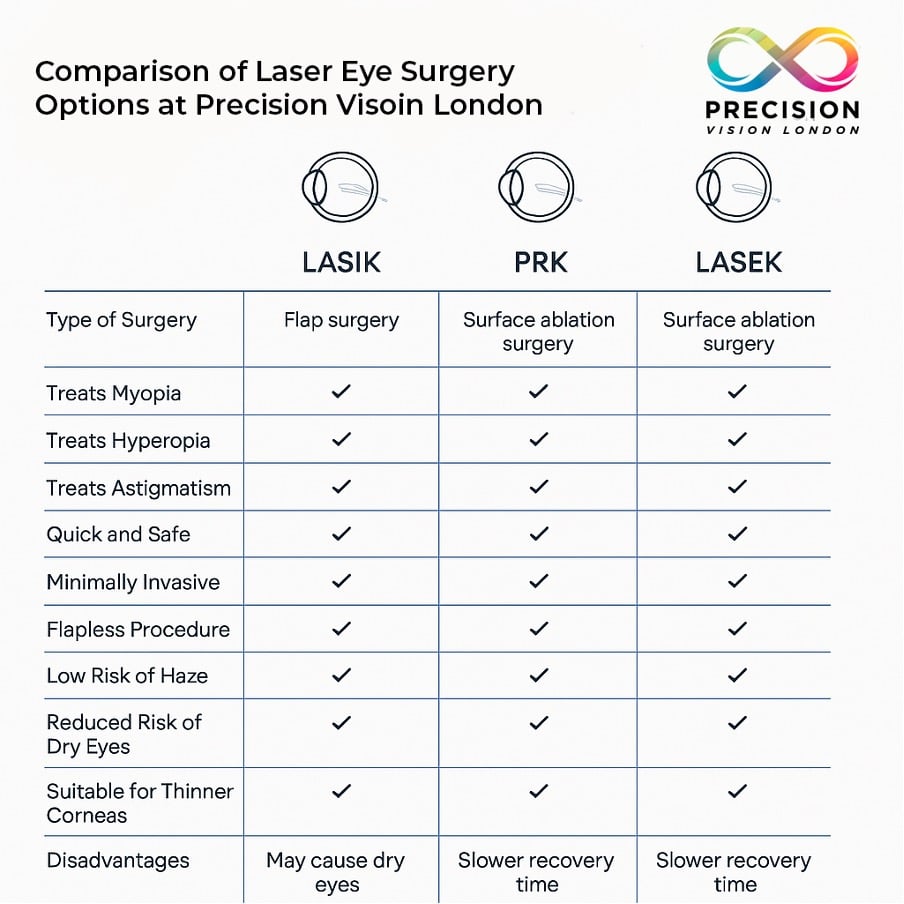
LASIK (Laser-Assisted In Situ Keratomileusis) stands as the most popular procedure. The surgeon creates a thin flap in your cornea’s outer layers with a laser or blade. An excimer laser then reshapes the exposed cornea with precision. The flap heals naturally without stitches after repositioning.
Other options include:
- SMILE – This newer technique creates a small tissue disc beneath the corneal surface. The surgeon removes it through a tiny keyhole incision.
- Surface treatments (PRK/LASEK/TransPRK) – Surgeons work directly on the corneal surface after removing its thin protective layer. These treatments work well for patients with thinner corneas.
Each procedure uses precise laser technology. The laser removes tiny amounts of corneal tissue to adjust the cornea’s curve. This helps focus light correctly onto the retina.
Why it’s a long-term solution
Your corneal shape changes permanently with laser eye surgery. A decade-long study followed 70 LASIK patients. They managed to keep healthy corneas and accurate vision throughout the study. The National Institute for Health and Clinical Excellence (NICE) reports no serious long-term safety concerns. More than 90% of patients achieve 20/20 vision or better. About 99% reach at least 20/40 vision good enough to handle most daily tasks without glasses or contacts. The cornea stays reshaped forever, but natural ageing might affect your vision. This happens especially when you have presbyopia, which typically starts after age 40.
Top advantages of laser eye surgery
Laser eye surgery offers life-changing benefits that go way beyond fixing your vision. Let’s look at the most important reasons why more people in the UK choose this procedure.
Freedom from glasses and contact lenses
You’ll feel an immediate sense of freedom once you ditch your corrective eyewear. Picture yourself swimming without prescription goggles, playing sports worry-free, and waking up with crystal clear vision, no more daily struggles with foggy lenses or irritated eyes from contacts. The newfound freedom works wonders 65% of patients become more physically active after their procedure.
Quick recovery and minimal downtime
Recovery happens remarkably fast with laser eye surgery. Patients see 80-90% of healing results on day one. LASIK patients usually head back to work within 48 hours. LASEK takes about seven days to heal. This quick bounce-back fits perfectly into busy lives.
Long-term cost savings
The original investment pays off nicely over time. Contact lens users spend between £288 and £660 annually. These costs add up to £4,780-£10,030 over ten years with 5.2% inflation. Most patients see their investment pay for itself in 5-7 years. You’ll save money and hassle by eliminating ongoing lens expenses.
Improved confidence and lifestyle
The benefits reach far beyond better eyesight. Patients feel more confident socially without glasses affecting their looks or contacts causing discomfort at key moments. In fact, 94.2% of patients say their lives improved after laser vision correction.
Safe and precise with advanced technology
Today’s laser systems use immediate eye-tracking technology that follows every tiny eye movement during surgery. This precision makes the procedure safer and more accurate by eliminating errors from slight movements.
High success rates in the UK
Success rates tell the most compelling story. Recent UK clinical studies show 99.2% of patients achieve 20/20 vision or better. Patient satisfaction soars too – 98.6% of UK patients love their post-surgery care.
Different types of laser eye surgery are explained.
Learning about different laser eye surgery procedures will help you make the right choice in your vision correction experience.

LASIK: benefits and limitations
LASIK stands as the most popular procedure and takes approximately 15 minutes per eye with minimal discomfort. The procedure uses a femtosecond laser to create a corneal flap, and an excimer laser reshapes the tissue. Most patients see improvements within 24-48 hours. LASIK works well for many people, but it’s not the best choice if you have thin corneas or dry eyes.
LASEK and PRK: when they’re preferred
LASEK and PRK treatments work directly on the corneal surface. The main difference is that PRK removes the epithelial layer completely, while LASEK preserves and puts it back after surgery. These procedures work best if you have thinner corneas (under 490-500 microns) or play contact sports. The recovery takes 4-7 days and causes more discomfort than LASIK in the beginning.
SMILE: a newer, less invasive option
SMILE (Small Incision Lenticule Extraction) brings the latest advancement in laser eye surgery. The procedure differs from LASIK as it doesn’t create a flap. Instead, it uses a tiny keyhole incision under 4mm to remove a lens-shaped piece of tissue. This gentle approach reduces dry eye symptoms and makes your cornea more stable. You can expect excellent vision within 24 hours, making SMILE perfect if you lead an active lifestyle.
Which type is right for you?
Your eye characteristics determine the best procedure for you. The decision depends on your corneal thickness, prescription strength, lifestyle, and any existing conditions like dry eyes. A complete consultation with an eye specialist will give you personalised advice to achieve the best results.
Risks, side effects, and who should avoid it
Laser eye surgery comes with risks you should know about before making your decision. The success rates are high, but you need to understand what it all means and set realistic expectations.
Common short-term side effects
Most patients experience temporary discomfort after surgery. Dry eyes can last up to three months, but artificial tears help manage this condition. Some people notice night-time glare or see halos around lights right after the procedure. These visual issues usually clear up within weeks or months as the corneal swelling goes down.
Rare but serious complications
Serious complications hardly ever happen. Your risk of getting permanently reduced vision is about 1 in 30,000, and vision loss happens in less than one case per five million. Infections occur in just 1 in 5,000 cases (0.02%) – nowhere near as often as infections from contact lenses.
Who may not be a good candidate
You might not be right for laser eye surgery if you have:
- A prescription that has changed in the last two years
- Thin or irregular corneas
- Active eye infections or uncontrolled medical conditions
- Pregnancy or breastfeeding (temporary restriction)
- Severe dry eyes or autoimmune disorders
How Precision Vision London ensures safety
Safety stands first at Precision Vision London. The clinic employs cutting-edge diagnostic equipment, including corneal mapping and tomography. Their complete pre-operative screening catches even subtle conditions that could affect your treatment’s success. Advanced eye-tracking systems can follow movements as tiny as 1 micron, which gives unmatched precision during the procedure.

Conclusion
Laser eye surgery is a revolutionary option to free yourself from corrective eyewear. The benefits go way beyond the reach and influence of just improving your vision. You’ll enjoy freedom from glasses and contacts, quick recovery times, and the most important, long-term cost savings make this procedure an excellent choice for many UK residents. The results speak for themselves – over 99% of UK patients achieve 20/20 vision or better. The psychological impact is just as remarkable, with 94.2% of patients reporting a better quality of life after their procedure.
Different procedures work for different needs. Your unique eye characteristics and lifestyle requirements will determine the right choice. LASIK gives a quick recovery for suitable candidates. LASEK and PRK are excellent alternatives if you have thinner corneas. SMILE shows the latest advancement with its minimally invasive approach. Side effects might happen temporarily, but serious complications are nowhere near as common as risks from long-term contact lens wear. Your safety stays protected with proper screening and expert care.
Precision Vision London’s complete pre-operative assessments help find the most suitable treatment for your specific needs. Advanced diagnostic equipment and precise eye-tracking systems deliver exceptional outcomes. Expert surgeons provide personalised care throughout your experience. Without doubt, laser eye surgery is a chance to see the world with clarity and confidence. The real question isn’t whether you can afford this procedure – it’s whether you can afford to miss out on these remarkable benefits for your vision and lifestyle.
FAQs
Q1. How long does the effect of laser eye surgery typically last? Laser eye surgery usually provides long-lasting vision correction. Most patients enjoy freedom from glasses for sports and socialising for many years. However, natural age-related changes may affect vision over time, particularly after age 40 when presbyopia typically develops.
Q2. What are the main advantages of laser eye surgery? Key benefits include freedom from glasses and contact lenses, quick recovery times, long-term cost savings, improved confidence, and high success rates. Over 99% of patients achieve 20/40 vision or better, allowing them to perform most daily activities without corrective eyewear.
Q3. Is laser eye surgery safe, and what are the risks? Laser eye surgery is generally very safe, with serious complications being extremely rare. The risk of permanently reduced vision is approximately 1 in 30,000. In contrast, vision loss occurs in less than one in five million cases. Common short-term side effects include temporary dry eyes and night-time glare, which typically resolve within a few months.
Q4. Who might not be suitable for laser eye surgery? Individuals with unstable prescriptions, thin or irregular corneas, active eye infections, uncontrolled medical conditions, severe dry eyes, or certain autoimmune disorders may not be good candidates. Pregnant or breastfeeding women are also typically advised to wait before undergoing the procedure.
Q5. How quickly can I expect to recover after laser eye surgery? Recovery times vary depending on the specific procedure, but are generally quick. Most LASIK patients experience 80-90% of healing within the first day and can return to work within 48 hours. LASEK recovery takes slightly longer, typically around seven days. Many patients achieve excellent vision within 24-48 hours post-surgery.