Vision Correction Treatments available in the morden world today are the safest way to achieve better eyesight. Three main vision correction options stand out: LASIK, ICL, and LASEK. LASIK remains the most popular type of laser eye surgery. It reshapes your cornea with an excimer laser to correct how light focuses on the retina. ICL works by placing an implantable collamer lens between the iris and your eye’s natural lens. LASEK takes a different path to reshape the cornea.
These treatments deliver outstanding results. More than 95% of LASIK patients end up with 20/20 vision or better. But each option has its own timeline and fits different needs. Most LASIK patients see better within 24 hours and get back to their routine in 24-48 hours. ICL patients need up to two weeks to recover fully. LASEK recovery takes 1-2 weeks, typically. Your prescription plays a significant role, too. LASIK can fix up to -10 diopters of myopia. ICL works better for severe myopia (up to -18 diopters) or people with thin corneas. In this piece, we’ll get into each treatment’s safety record. You’ll learn which option might work best for your eyes. This comparison gives you key facts to pick the proper vision care path, whether you want laser eye surgery in London or LASIK surgery on Harley Street.

Understanding the Three Vision Correction Options
Your vision correction options are different from each other, and knowing these differences helps you choose the correct procedure for your eyes. Each treatment works better for specific vision problems and fits different lifestyles.
What is LASIK surgery and how does it works
LASIK (Laser-Assisted in Situ Keratomileusis) is the most popular laser eye surgery today. The surgeon creates a thin flap in your cornea using either a microkeratome blade or a femtosecond laser. The surgeon lifts this flap and uses an excimer laser to reshape the corneal tissue underneath. This corrects refractive errors like myopia, hyperopia, and astigmatism. The whole process takes just 10-15 minutes per eye. Your flap goes back in place and sticks naturally without stitches. You’ll likely see better within 24-48 hours after the procedure.
What is ICL surgery and how is it different
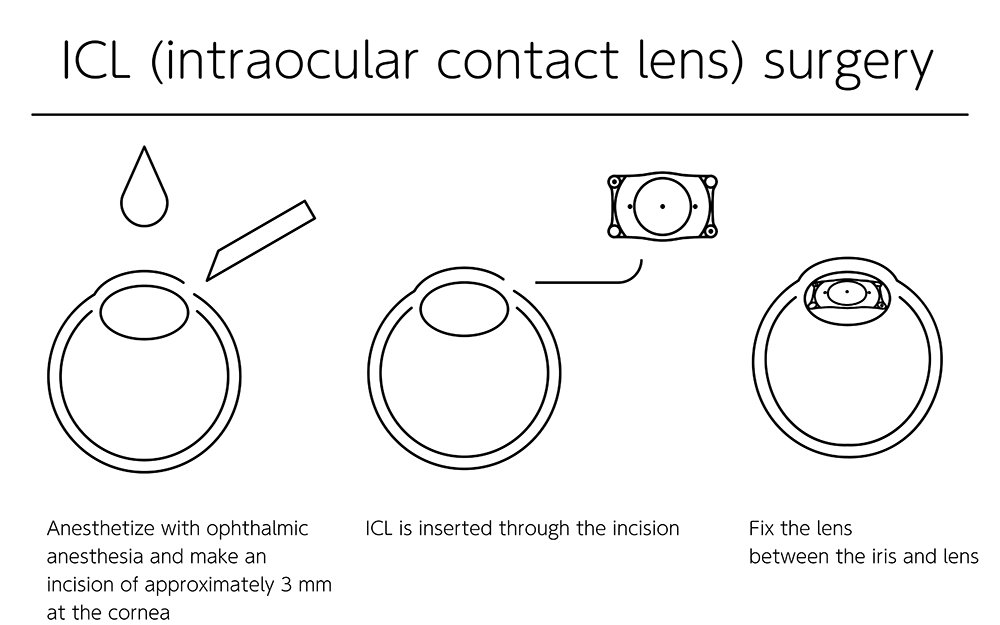
ICL (Implantable Collamer Lens) surgery takes an entirely different path to fix your vision. The surgeon implants a biocompatible lens between your iris and natural lens instead of reshaping your cornea. The surgery usually takes 20-30 minutes to complete. ICL adds to your eye rather than removing tissue. This makes it great for you if you have thin corneas or prescriptions that are too high for LASIK. You can also have the implanted lens removed or replaced if needed – something you can’t do with LASIK.
What is LASEK, and when is it used
LASEK (Laser Epithelial Keratomileusis) works well if LASIK isn’t right for you. The surgeon lifts the outer layer of your cornea (epithelium) with an alcohol solution instead of making a flap. An excimer laser reshapes your cornea, and then the epithelial layer goes back in place to help with healing. You’ll wear a protective contact lens for about a week. We recommend LASEK if you have thin corneas, play contact sports, do high-impact activities, or have dry eye syndrome. Recovery takes longer than LASIK – about 1-2 weeks -, but LASEK gives excellent results for specific eye conditions.
Comparing Safety and Effectiveness
Safety plays a vital role in choosing the proper vision correction treatment. Let’s get into how these procedures stack up against each other on essential safety metrics.

Corneal Impact: LASIK vs ICL vs LASEK
The corneal tissue’s preservation remains a critical safety factor. LASIK permanently removes corneal stroma to fix refractive errors, which can weaken the cornea and make it unsuitable for patients with thin corneas. ICL proves ideal for thin or irregular corneas because it doesn’t touch the corneal tissue at all. LASEK provides a middle ground by treating just the surface layer and saves more corneal tissue than LASIK.
Reversibility: Permanent vs removable options
EVO ICL stands out as the only vision correction procedure you can fully reverse. Doctors can remove or replace the implanted lens if your vision needs change. This flexibility isn’t possible with laser-based treatments. LASIK and LASEK make permanent changes to corneal tissue, and once removed, there’s no way to replace it.
Dry Eye and Night Vision: Which performs better?
Up to 95% of LASIK patients experience dry eye syndrome right after surgery, and about 60% still have symptoms after a month. ICL surgery keeps the corneal nerves that control tear production intact, which helps avoid surgery-related dry eye problems. Night vision issues like halos and glare are common for LASIK and LASEK patients at first. ICL patients often see better at night because their cornea’s natural shape stays unchanged.
Who is the Best Candidate for Each Procedure?
Your eyes’ unique characteristics determine the best vision correction treatment. Each procedure has specific requirements that help find the perfect option for you.
LASIK: For stable prescriptions and healthy corneas
LASIK works best when you have enough corneal thickness to create a flap safely. You make an ideal candidate if your prescription hasn’t changed for at least 12 months and you’re over 18. LASIK can correct myopia up to -10 diopters, though results are better within -6 diopters due to the corneal thickness needs. This procedure isn’t correct for you if you have thin corneas, severe dry eye syndrome, or certain autoimmune conditions.

ICL: For high prescriptions and thin corneas
ICL surgery stands out as a great choice if your corneas are too thin for laser procedures. This option suits people aged 21-45 who have moderate to severe myopia (up to -18 diopters), astigmatism (up to 6 diopters), or hyperopia (up to +10 diopters). ICL is also a reversible solution that keeps your corneal tissue intact.
LASEK: For active lifestyles and surface-level correction
LASEK is perfect if you play contact sports or have a physically demanding job. This surface-level procedure suits thinner corneas that don’t meet LASIK requirements. LASEK also provides better long-term stability for biomechanically weak corneas and avoids complications related to flaps.
Why Choose Precision Vision London
The right clinic for vision correction depends on expertise, technology, and personalised care. Precision Vision London combines exceptional eye care with state-of-the-art innovation.

Expert surgeons with years of UK-based experience
Dr CT Pillai leads Precision Vision London with over 30 years of ophthalmic expertise. He has performed more than 50,000 LASIK, LASEK and PRK procedures. His pioneering work made him one of the first UK surgeons to perform bilateral laser surgery. Specialist journals have recognised his surgical skills and remarkably low complication rates.
Advanced diagnostic and surgical technology
The clinic uses the SCHWIND AMARIS®️ 1050RS exclusively. This world’s highest-performance eye laser for refractive surgery completes treatments in just 1.3 seconds per dioptre. A sophisticated 7D eye tracking system adapts instantly to all eye movements.
Personalised treatment plans for every patient
Experienced refractive specialists conduct detailed 2-hour consultations with thorough tests for each patient. Your eye characteristics and lifestyle needs shape a bespoke treatment plan.
Trusted care on Harley Street, London
This independent, surgeon-led practise sits in London’s clinical heart. The clinic has earned an impressive 4.97/5 rating from 167 verified patient reviews. World-class practitioners and state-of-the-art equipment reflect the clinic’s steadfast dedication to premium eye care excellence.
Conclusion
Your unique eye characteristics and lifestyle needs determine which vision correction treatment works best for you. Each procedure has its own benefits. LASIK gives quick recovery and excellent results if you have stable prescriptions and healthy corneas. ICL is the only reversible option that works great for patients with high prescriptions or thin corneas. LASEK proves to be a solid choice for active people who need surface-level correction. Your safety should guide your choice. These treatments affect corneal tissue differently. ICL keeps corneal integrity intact. LASEK only affects the surface layer, while LASIK removes corneal stroma. Side effects like dry eye syndrome and night vision issues vary between procedures. ICL typically has fewer complications in these areas.
A detailed consultation at Precision Vision London helps determine which procedure matches your needs. Dr CT Pillai and his team bring over 30 years of eye care expertise to your treatment plan. You’ll benefit from world-class surgical skills that come with very low complication rates. The clinic’s innovative technology improves your safety and results. The SCHWIND AMARIS®️ 1050RS laser system with advanced 7D eye tracking delivers precise vision correction that matches your exact needs.
Your path to better vision needs trusted care from a surgeon-led practise that has done thousands of successful procedures. As you think about your options for vision correction, note that Precision Vision London’s expertise, technology, and personalised approach give you the confidence to make this life-changing decision. Your vision matters trust it to specialists who know both the science and art of vision correction.
Key Takeaways
Understanding the safety profiles and suitability of different vision correction treatments helps you make an informed decision about your eye care.
- ICL is the safest option for thin corneas and high prescriptions, preserving corneal tissue whilst offering the only fully reversible vision correction procedure.
- LASIK provides the fastest recovery (24-48 hours) but carries a higher dry eye risk (95% initially) and permanently removes corneal tissue.
- LASEK suits active lifestyles and contact sports, treating only the surface layer whilst avoiding flap-related complications entirely.
- Prescription strength determines suitability: LASIK corrects up to -10 dioptres, whilst ICL handles severe myopia up to -18 dioptres effectively.
- Expert consultation is essential corneal thickness, age, lifestyle, and eye health determine which procedure offers optimal safety and results for you.
The key to successful vision correction lies in matching the proper procedure to your specific eye characteristics and lifestyle requirements, ensuring both safety and long-term satisfaction with your results.
FAQs
Q1. Which vision correction procedure is safest for thin corneas? ICL (Implantable Collamer Lens) surgery is generally considered the safest option for those with thin corneas. Unlike LASIK or LASEK, ICL doesn’t involve removing any corneal tissue, making it ideal for preserving corneal integrity.
Q2. How do recovery times compare between LASIK, ICL, and LASEK? LASIK typically offers the quickest recovery, with most patients returning to normal activities within 24-48 hours. ICL recovery can take up to two weeks, while LASEK usually requires 1-2 weeks for full recovery.
Q3. Are there any reversible vision correction procedures? Yes, ICL is currently the only fully reversible vision correction procedure. The implanted lens can be removed or replaced if vision needs change, offering flexibility that laser-based treatments like LASIK and LASEK cannot provide.
Q4. Which procedure is best for correcting high levels of myopia? ICL is particularly effective for correcting high levels of myopia, capable of treating up to -18 diopters. In comparison, LASIK is generally limited to correcting up to -10 diopters, with optimal results typically seen in the -6 diopter range.
Q5. How do these procedures compare in terms of dry eye risk? LASIK carries the highest risk of dry eye, with up to 95% of patients experiencing symptoms immediately after surgery. ICL, on the other hand, has a minimal risk of causing dry eye as it doesn’t affect the corneal nerves responsible for tear production. LASEK falls somewhere in between, with a lower risk than LASIK but higher than ICL.