
Laser Eye Surgery in London
Reduce or end your dependence on glasses and contact lenses with LASIK, LASEK/TransPRK or SMILE — performed personally by GMC-registered surgeons on Harley Street using the Schwind Amaris 1050RS.

- Free consultation (£100 holding fee, refunded)
- All diagnostics & aftercare included
- Free enhancement within 12 months







What is laser eye surgery?
Laser eye surgery reshapes the front surface of your eye — the cornea — with a precision laser, correcting short-sightedness, long-sightedness and astigmatism so light focuses clearly on the retina, reducing or removing your need for glasses and contact lenses.
At Precision Vision London it's a walk-in, walk-out day procedure taking around 10–20 minutes per eye under local anaesthetic drops. Most people return to everyday activities within a day or two. Your surgeon selects the right technique — LASIK, LASEK/TransPRK or SMILE — for your prescription, corneal thickness and lifestyle.
Not sure it's right for you? You may be a candidate for lens replacement surgery or ICL implants instead — we'll advise honestly at your consultation.
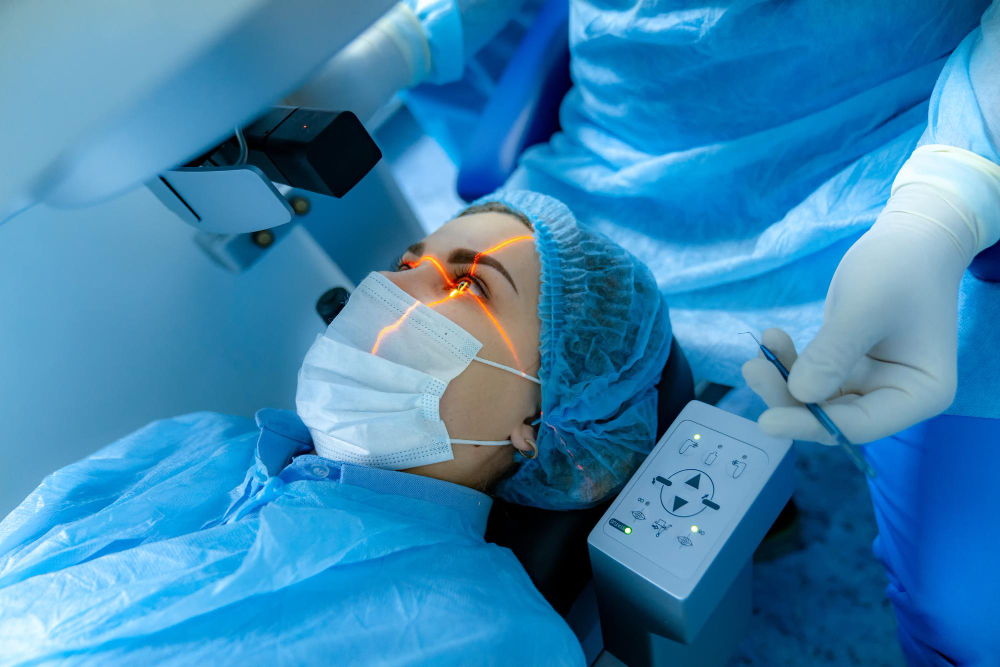
The clarity of the Schwind Amaris 1050RS
One of the fastest, most advanced laser platforms available — tracking your eye over 1,000 times a second for a treatment mapped to the unique imperfections of each eye. It's the technology behind our results, and it's included in your all-inclusive price.
Book Your Free Assessment
Types of laser eye surgery we offer
Your surgeon recommends the safest, most effective option for your eyes at your consultation.
LASIK
The most popular technique. A thin flap is created and the cornea reshaped underneath — fast healing, with clearer vision typically within 24–48 hours.
LASEK / TransPRK
A surface (no-flap) treatment ideal for thinner corneas or more active lifestyles. Healing takes a little longer, around 5–7 days.
SMILE
A minimally invasive, keyhole laser procedure through a tiny incision — a flapless option well suited to short-sightedness. Performed by Dr Radwan Almousa.
Presbyond Blended Vision
For over-40s wanting freedom from reading glasses — laser blended vision extends your range of focus from near to far.
Wavefront / custom
Advanced measurements map the unique imperfections of each eye for a treatment tailored to your individual vision.
Aftercare & enhancement
All post-operative appointments through your first year, plus any enhancement procedure if needed — at no extra cost.
Looking for PTK (phototherapeutic keratectomy)? PTK is a therapeutic laser treatment for corneal surface conditions rather than a vision-correction procedure, so it has its own dedicated page — read about PTK.
Am I suitable for laser eye surgery?
Most people with a stable prescription and healthy eyes are suitable — but the only way to know for certain is a comprehensive consultation. As a guide:
Often a good candidate
- Aged 18+ with a prescription stable for ~12 months
- Short-sighted, long-sighted or have astigmatism
- Healthy eyes and good general eye health
- Tired of the limits of glasses or contact lenses
May need an alternative
- Thin or irregular corneas — ICL may suit better
- Very high prescriptions beyond laser range
- Early cataract — lens replacement may be recommended
- Pregnant or breastfeeding (prescription can fluctuate)
What happens, step by step
Free, surgeon-led consultation
A detailed 60–90 minute assessment led by your surgeon, with advanced diagnostic scans, confirms whether you're a candidate and which technique suits your eyes.
Your personalised treatment plan
Your surgeon explains your options, expected outcome, risks and costs — with no pressure and no obligation to proceed.
Treatment day
The laser procedure itself takes around 10–20 minutes per eye under anaesthetic drops. You'll rest briefly, then be driven home the same day.
Recovery & aftercare
Most LASIK patients see clearly within 24–48 hours. We review you through your first 12 months, with any enhancement included.
Benefits and risks
Good clinical care means being clear about both. Your surgeon will discuss all of this with you in person before you decide.
Benefits
- Reduced or ended reliance on glasses and contact lenses
- Quick procedure with a fast recovery for most patients
- Long-lasting correction of short/long sight and astigmatism
- Greater freedom for sport, travel and daily life
Possible risks & side-effects
- Temporary dry eyes or fluctuating vision while healing
- Glare, haloes or starbursts around lights, usually short-lived
- Occasionally an enhancement is needed to fine-tune the result
- As with any surgery, rarer complications are possible
Outcomes vary between individuals; no surgical result can be guaranteed. Your surgeon will assess your suitability and discuss the risks specific to you at consultation.
How much does laser eye surgery cost?
Laser eye surgery at Precision Vision London starts from £1,950 per eye for LASIK and LASEK, or from £36.04 per month with 0% finance. Every price is all-inclusive — consultation, diagnostics, the procedure, aftercare and any enhancement in the first year.
LASIK & LASEK
Our most requested treatments, including TransPRK surface laser.
Blended Vision
Freedom from reading glasses for over-40s.
SMILE
Minimally invasive keyhole laser correction.
See the full laser eye surgery cost breakdown and 0% finance options, or book a free consultation for a personalised quote.
Dr CT Pillai
With more than 50,000 vision-correction procedures over a career spanning almost 50 years, Dr Pillai was among the first surgeons in the UK to perform bilateral laser eye surgery. He leads our laser and keratoconus programmes. SMILE laser procedures are performed by our consultant colleague Dr Radwan Almousa (GMC 6033647). Every patient is treated by a consultant surgeon, never a technician.
Find out if laser eye surgery is right for you
Book a free, no-obligation, surgeon-led suitability consultation on Harley Street. We'll assess your eyes, answer your questions, and give you an honest recommendation — with no pressure to proceed.

Request your free consultation
What our laser patients say
"Many thanks to Mr Pillai and his team — they were all superbly professional throughout. I still can't quite believe how well I can see less than 48 hours down the line, but it is amazing."
"I was quite nervous about the procedure, but every member of staff was competent and confident, which put my mind at ease. My husband had laser eye surgery 10 years ago and his eyesight is still perfect — reassuring proof the results are long-lasting."
"Top-quality attention and top-quality equipment. That made me very confident — it was an excellent job and I feel so good with my vision, and so happy. I recommend everyone to see the clinic."
Laser eye surgery FAQs
How much does laser eye surgery cost in London?
Is laser eye surgery safe?
Does it hurt?
How long does recovery take?
What if I'm not suitable for laser?
Is there an age limit?
Ready to see life without glasses?
Book your free suitability consultation on Harley Street today. No obligation, no pressure — just an honest, expert assessment of your options.
Book a Free Suitability Consultation 020 3884 6805