Refractive Lens Exchange (RLE) — also known as Lens Replacement Surgery or Clear Lens Exchange — is a vision correction procedure that replaces your eye’s natural lens with a custom intraocular lens (IOL) to correct short-sightedness, long-sightedness, astigmatism, and presbyopia in a single operation.
At Precision Vision London, RLE is performed by Dr Radwan Almousa (Consultant Ophthalmic Surgeon) at our Harley Street clinic, with Dr CT Pillai (Medical Director) leading consultations and aftercare.
Refractive Lens Exchange (RLE) — also known as Lens Replacement Surgery or Clear Lens Exchange — is a vision correction procedure that replaces your eye’s natural lens with a custom intraocular lens (IOL) to correct short-sightedness, long-sightedness, astigmatism, and presbyopia in a single operation.
At Precision Vision London, RLE is performed by Dr Radwan Almousa (Consultant Ophthalmic Surgeon) at our Harley Street clinic, with Dr CT Pillai (Medical Director) leading consultations and aftercare.
Medically reviewed by Dr Radwan Almousa MD, FRCOphth, CertLRS — Consultant Ophthalmic Surgeon (GMC: 6033647). Consultations and aftercare led by Dr CT Pillai MD, DO, FRCS (Edin), FRCOphth (UK) — Medical Director (GMC: 351798).
Last reviewed: April 2026 · Next review: April 2027
Rated by London Patients
years of surgical experience
1-Year on all Treatments
Alcon Refractive Suite
Precision Vision London is a surgeon-led private eye clinic on Harley Street — London’s most established private medical district. We perform Refractive Lens Exchange, cataract surgery, laser eye surgery, and implantable contact lens (ICL) procedures.
The lens inside your eye sits behind the pupil and focuses light onto the retina. With age, this natural crystalline lens becomes less flexible, eventually causing the reading difficulty known as presbyopia. It can also become cloudy, forming a cataract.
Refractive Lens Exchange replaces this natural lens with an artificial intraocular lens (IOL) — a custom-made implant that corrects your specific prescription. The procedure is also known as Clear Lens Exchange (CLE), Lens Exchange Surgery, Natural Lens Replacement, or Refractive Lens Replacement Surgery. All terms describe the same operation.
RLE is identical to cataract surgery in surgical technique. The only difference is the reason it is performed: cataract surgery removes a cloudy lens to restore vision, while RLE removes a clear lens to correct refractive error and reduce dependence on glasses.
Lens replacement is one of the most commonly performed surgical procedures worldwide. Data from the European Registry of Quality Outcomes for Cataract and Refractive Surgery (EUREQUO) captured 330,202 cases from 16 countries in 2019 alone, with refractive lens exchange accounting for 46.6% of reported refractive surgery procedures.
Refractive Lens Exchange is suitable for a wider range of prescriptions than laser surgery. At Precision Vision London, we regularly treat:
Prescriptions outside these ranges are assessed individually. We can often treat complex cases that high-volume chain clinics cannot take on. If your prescription falls outside these ranges, or you have been told you are unsuitable for vision correction elsewhere, a consultation is the only way to confirm what we can achieve for you.
RLE is not suitable for everyone. Suitability is determined at your consultation based on your prescription, eye health, age, lifestyle, and occupation. Every patient at Precision Vision London receives a two-hour consultation before any treatment is recommended.
Only an in-person consultation with full diagnostics can confirm suitability. A phone assessment with our patient coordinators will establish whether a consultation is appropriate before any fees are charged.
Some patients fall into a grey area where suitability depends on detailed assessment. We will review your case individually if you:
Yes — in many cases. We frequently see patients who have been told at other clinics that they are not candidates for vision correction. Common reasons include:
In many of these cases, RLE with a premium IOL produces a more stable and predictable outcome than laser surgery would have. Published research on RLE in modern practice (Alió et al.) supports this, particularly for patients with high degrees of hyperopia or presbyopia.
If you’ve been told you’re not suitable for vision correction elsewhere, a consultation at Precision Vision London is worth the second opinion. We will not recommend a procedure that isn’t right for you — but we have often been able to help patients who had been given up on.
“Many of the patients I see at Precision Vision London have been told elsewhere that they aren’t suitable for laser eye surgery — usually because their prescription is too high, or their corneas are too thin. For these patients, RLE with a trifocal lens often yields a better outcome than laser alone would have. Suitability is individual, which is why a thorough consultation matters.”
— Dr Radwan Almousa
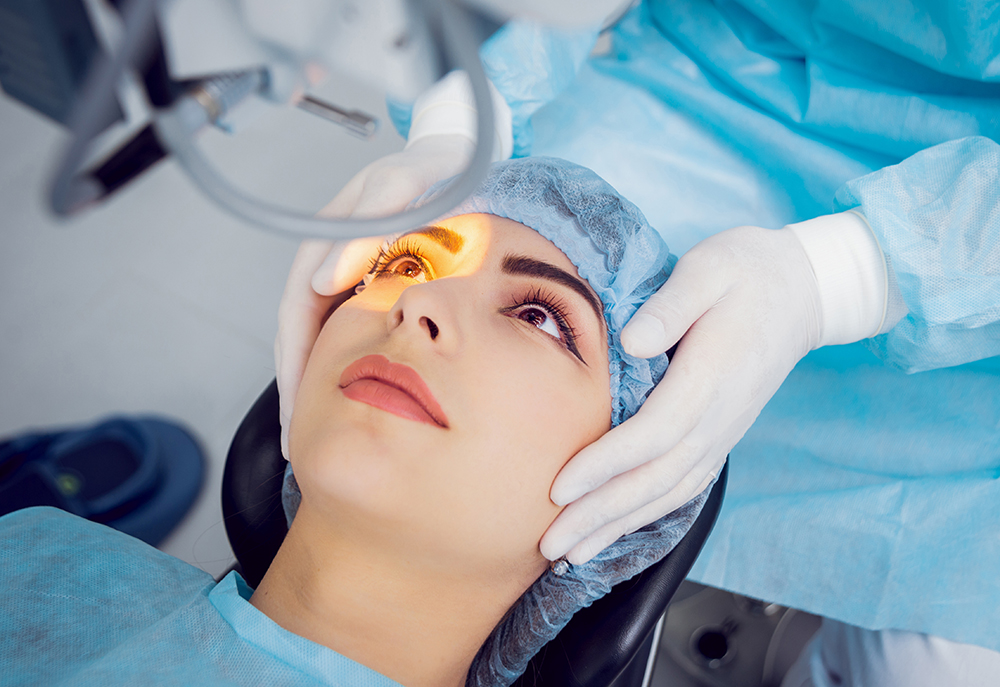
Refractive Lens Exchange is a day-case procedure performed under local anaesthetic. You will be awake but will not feel pain. Most patients describe the experience as comfortable and straightforward.
The procedure follows these stages for each eye:
Each eye takes around 20 minutes. At Precision Vision London, both eyes can usually be treated on the same day, depending on your suitability. The procedure is performed by Dr Almousa at our Harley Street clinic using the Alcon Refractive Suite.
Your first post-operative check takes place the day after surgery, led by Dr Pillai and our clinical team.
The choice of lens implant is the most important decision in the whole procedure. It determines what you will actually see after surgery — at what distances, with what clarity, and under what lighting conditions.
At Precision Vision London, we specialise in Trifocal IOLs. As an independent clinic with no manufacturer affiliations, we select lenses based solely on what suits each patient’s eye anatomy and lifestyle — not on commercial agreements with any lens maker.
| Lens type | Vision corrected | Typically suited to |
|---|---|---|
| Monofocal | Distance vision correction | Patients comfortable using reading glasses or with demanding night vision requirements |
| Monofocal Toric | Distance vision correction with astigmatism | As above, where astigmatism is present |
| Multifocal / Trifocal | Distance, reading and intermediate vision correction | Patients seeking full spectacle independence |
| Multifocal Toric | Distance, reading and intermediate vision correction with an astigmatism | As above, where astigmatism is present |
Monofocal (spherical or toric): Best suited to patients who are comfortable continuing to use reading glasses, or who have occupational night vision demands where multifocal halos would be a problem — for example, HGV drivers or commercial pilots. Also a sensible choice for patients with early macular changes or other retinal conditions where multifocal lenses would compromise image quality.
Multifocal / Trifocal (spherical or toric): Our default recommendation for patients seeking full spectacle independence across near, intermediate, and distance. Most suitable for patients with stable prescriptions, healthy retinas, and regular pupils. Dry eye, if present, can usually be treated prior to surgery. This is the lens type most of our patients choose, in line with ESCRS Clinical Trends Survey data showing trifocal IOLs account for approximately 50% of presbyopia-correcting IOL cases across Europe.
The three trifocal IOLs we offer:
Your surgeon will recommend the specific lens at consultation based on your biometry, pupil size, corneal topography, and lifestyle.
Blended monovision with monofocals is also available as an alternative for patients who want reduced glasses dependence but are unsuitable for multifocals — for example, those with certain macular conditions or occupations where trifocal halos would be unacceptable.
For patients with astigmatism who also want full spectacle independence, multifocal toric IOLs combine trifocal vision (distance, intermediate and near) with astigmatism correction in a single lens. RLE can correct astigmatism up to approximately 12.00 dioptres.
Vision after trifocal lens implantation takes time to settle. Distance vision is usually the first to stabilise, typically within 24 to 48 hours. Near vision can take one to four weeks to fully adjust as the eye heals.
Beyond the initial healing, the brain undergoes a process called neuroadaptation — learning to automatically select the right focal zone from the three available. This is not a complication; it’s a normal part of adapting to Multifocal/Trifocal IOLs. Most patients fully adapt within three to six months, though some visual effects, such as mild glare and halos at night, can take up to a year to fully resolve.
No intraocular lens is perfect. Trifocal IOLs provide the widest range of unaided vision but can produce:
Monofocal IOLs have fewer visual disturbances but typically require reading glasses afterwards.
The right lens for you depends on what matters most in your daily life. This decision is made together at your consultation, based on your prescription, eye anatomy, pupil size, occupation, and lifestyle — not on a default template.
Our approach revolves around prioritising your optimal well-being throughout your Refractive Lens Exchange journey.
Your first point of contact will be with Precision Vision London’s highly trained patient coordinators, who will discuss your prescription, lifestyle and suitability before any consultation fees are charged.
RLE is a day-case procedure under local anaesthetic, taking approximately 20 minutes per eye. Both eyes can usually be treated the same day. Dr Almousa performs every procedure personally using the Alcon Refractive Suite.
Your two-hour consultation includes full diagnostic imaging, biometry, topographic mapping and a personalised treatment plan discussed with your surgeon. Lens selection is tailored to your individual eye anatomy and lifestyle.
Your 12-month aftercare programme includes scheduled post-operative reviews, all medication for the first month, 24-hour telephone access, and laser fine-tuning if required — all included in the price.
Most patients notice a significant improvement in vision within 24 to 48 hours of surgery. Near vision can take one to four weeks to fully adjust as the eye settles.
You will be given antibiotic and anti-inflammatory eye drops to use during recovery. Your clinical team will provide written instructions and remain available throughout the aftercare period.
Please contact the clinic without delay if you experience any of the following after surgery:
Our team is available 24 hours a day following your treatment.
Our pricing is transparent and inclusive. There are no hidden extras. Published fees are minimum prices — specialist treatments, high- or complex-prescription medications, complicated cases, or patients who have had previous eye surgery may incur higher costs. Any additional cost will always be discussed and agreed upon at the consultation, before treatment is scheduled.
| Treatment | Per eye (from) | Both eyes (from) |
|---|---|---|
| Initial consultation | Free if proceeding with surgery (£300 booking deposit) | |
| Monofocal lens | £3,000 | £6,000 |
| Monofocal Toric lens | £3,250 | £6,500 |
| Multifocal (Trifocal) lens | £3,550 | £7,100 |
| Multifocal Toric lens | £3,995 | £7,990 |
| YAG laser (if required post-op) | £500 | £1,000 |
The lens used depends on whether you have astigmatism and the results of your consultation.
Two finance plans are available through our regulated finance partner:
Finance is available subject to status. Finance cannot be combined with any other offers. Your personal rate and repayment terms will be confirmed at the consultation, once your lens choice and treatment plan are finalised.
Precision Vision London Ltd is an introducer appointed representative (IAR) of Ideal Sales Solutions Ltd T/A Ideal4Finance. Ideal Sales Solutions is a credit broker and not a lender (FRN 703401). Finance available subject to status. The rate offered is always provisional and will depend on your personal circumstances, the loan amount, and the term.
Your Refractive Lens Exchange package at Precision Vision London includes:
Refractive Lens Exchange is classified as an elective vision correction procedure and is not funded by the NHS. Patients seeking RLE in the UK are treated privately.
At Precision Vision London, private care means:
Private medical insurance policies typically do not cover elective RLE, as it is classified as vision correction rather than treatment for disease. Some policies may contribute towards consultation fees or diagnostic imaging. Precision Vision London is recognised by Bupa, Cigna, Aviva, WPA, The Exeter, Allianz, and Simplyhealth — please contact us with your policy details to confirm your coverage.
If you have an early cataract that meets clinical criteria for treatment, your insurer may cover the surgical element while you pay the difference for premium lens upgrades. We can provide documentation to support your insurance enquiry.
Laser eye surgery (LASIK, LASEK, PRK) and Refractive Lens Exchange are both vision correction procedures, but they work very differently.
Laser eye surgery reshapes the surface of the cornea to change how light is focused onto the retina. It is most suitable for patients in their 20s to early 40s with stable, moderate prescriptions and healthy corneas.
Refractive Lens Exchange replaces the lens inside the eye. It is typically more suitable for:
Published clinical research indicates that, particularly for patients with high degrees of long-sightedness (hyperopia), RLE often yields a more stable and predictable result than laser surgery.
An in-person consultation is the only way to confirm which procedure is right for your eyes.
Refractive Lens Exchange is a well-established procedure with a strong safety record, but the risk of complications is not zero. Your surgeon will discuss your individual risk factors at the consultation.
Data from the Royal College of Ophthalmologists Cataract Surgery Commissioning Guidance shows that 85% of patients achieve refraction within ±1.00 dioptre of target after cataract/lens surgery, with posterior capsular rupture (the main intraoperative complication) occurring in approximately 1–2% of cases nationally. Careful patient selection, surgeon experience, and the use of current technology further reduce these risks.
Dr Almousa will discuss your individual risk profile in full during your consultation. Informed consent is an essential part of our process.
A clouding of the lens capsule (where the lens sits), not the lens itself. It is called "secondary cataract" but it is not a cataract — a cataract is the clouding of the lens, while PCO is a clouding of the lens capsule. It usually occurs due to the healing process after surgery and there is no way to predict who will heal like this. Treatable with a simple YAG laser procedure, which is included if it develops within the first 12 months of aftercare. If it occurs after the 12-month aftercare period, the YAG laser procedure will be charged separately.
Common in the first few months, especially at night with multifocal IOLs. Usually reduce over time.
A rare infection inside the eye. With the antibiotic drops provided after surgery, this risk is minimised significantly. Requires urgent treatment but is uncommon when surgery is performed in a properly sterilised clinical environment.
Some patients need a mild glasses prescription after surgery. This can happen as part of the natural healing process. Can often be corrected with laser fine-tuning, which is included in our 12-month aftercare.
A serious but rare complication, primarily affecting patients with very high myopia. Long-term follow-up studies report retinal detachment in approximately 3.2% of high-myopia RLE cases in published series.
Some patients need a mild glasses prescription after surgery as part of the natural healing process. This can often be corrected with laser fine-tuning, which is included in our 12-month aftercare.
A serious but rare complication, primarily affecting patients with very high myopia. Long-term follow-up studies report retinal detachment in approximately 3.2% of high-myopia RLE cases in published series.
Refractive Lens Exchange starts from £3,000 per eye (from £6,000 for both eyes) for monofocal lenses, rising to £3,995 per eye (from £7,990 for both eyes) for multifocal toric lenses. Final pricing depends on the lens type recommended at your consultation. Consultation is free if you proceed with surgery; a £300 booking deposit is required to reserve your consultation. Finance is available from £37.10 per month (60 months at 9.9% APR, subject to status).
The procedure takes around 20 minutes per eye. It is performed as a day case under local anaesthetic, and both eyes can usually be treated on the same day.
The surgical technique is identical. The difference is the reason: cataract surgery removes a cloudy lens to restore vision, while RLE removes a clear lens to correct refractive error and reduce dependence on glasses.
There is no upper age limit for RLE, provided your eyes are healthy. Many of our patients are over 60. Suitability is determined by the health of your eyes, not age alone.
With trifocal IOLs, most patients achieve full or near-full spectacle independence. With monofocal IOLs, you will typically still need reading glasses. Your lens choice at the consultation determines the outcome.
There is no single "best" IOL. The right choice depends on your prescription, eye anatomy, pupil size, lifestyle and occupation. Most of our patients choose a trifocal IOL for full spectacle independence. Patients with demanding night vision requirements or early macular changes are often better suited to a monofocal IOL. Your surgeon will recommend the specific lens at consultation based on your biometry and lifestyle.
Most patients are able to drive two to three days after surgery, once their consultant confirms their vision meets the UK legal driving standard. Distance vision typically stabilises within 24 to 48 hours. Never drive until your consultant has confirmed you are safe to do so.
No. Refractive Lens Exchange is classified as an elective vision correction procedure and is not funded by the NHS. It is available privately at clinics like Precision Vision London.
Private medical insurance policies typically do not cover elective RLE, as it is classified as vision correction rather than treatment for disease. Some policies may contribute towards consultation or diagnostic fees. Precision Vision London is recognised by Bupa, Cigna, Aviva, WPA, The Exeter, Allianz, and Simplyhealth — please contact us with your policy details to confirm your coverage.
Yes, in most cases. Same-day bilateral treatment is suitable for most patients and is confirmed during your consultation.
No. The lens sits inside the capsular bag where your natural lens used to be. There are no nerves in that part of the eye, so you will not feel it, and no one will be able to see it.
Dr Radwan Almousa MD, FRCOphth, CertLRS (GMC: 6033647) — Consultant Ophthalmic Surgeon and current NHS Consultant. Fellowships in Refractive Surgery and Corneal & Anterior Segment Diseases; Oculoplastics (National University Hospital, Singapore); and Cornea, Anterior Segment & Refractive Surgery (Queen Victoria Hospital, UK). 18 peer-reviewed publications across cornea, refractive, and oculoplastic subspecialties. Previously held posts at Moorfields Eye Hospital, Queen Victoria Hospital, and The Wellington Hospital. Dr Almousa performs every RLE procedure at Precision Vision London.
Our surgeons perform procedures at 22a and 15 Harley Street — a Care Quality Commission (CQC) regulated clinic. Both Dr Almousa and Dr Pillai are fully registered with the General Medical Council (GMC) and hold Fellowships of the Royal College of Ophthalmologists (RCOphth). Precision Vision London is a registered data controller under the UK GDPR and Data Protection Act 2018.
If you have concerns about the treatment you have received, we ask that you speak with your surgeon first. You can also contact the General Medical Council (gmc-uk.org), the Care Quality Commission (cqc.org.uk), or — for data protection matters — the Information Commissioner’s Office (ico.org.uk). Our clinic’s formal complaints procedure is available on request.
Doctify Patient Experience Award winner
Aftercare programme on all procedures
Bupa, Cigna, Aviva, WPA, Allianz, Exeter, Simplyhealth
Independent optometrist aftercare network
Below are stories from patients who have undergone Refractive Lens Exchange or Clear Lens Exchange at Precision Vision London.
“I felt very confident with the service I received. The eyes are a difficult area to make the decision to go ahead with surgery, but I was reassured at all times. Everybody was very nice, friendly and confidence-inspiring. I now have 20/20 vision, probably for the first time since I was about 7-8 years old, 42-43 years!“
— Sue D · Lens Replacement
“The whole experience of my Clear Lens Exchange procedure was amazing. The level of care and attention I received was exceptional. I felt completely relaxed and confident throughout, and even though there were several other people having the same procedure as myself, you made me feel like the ‘only one.’”
— G. Margaret · Clear Lens Exchange
“The whole process is very well organised. The CLE treatment I received was straightforward, painless, and most professionally carried out — about 15 minutes per eye. After wearing spectacles for over 53 years with a +9 prescription, the result is amazing. Peripheral vision is superb, and being able to see others clearly when swimming is a whole new experience.“
— Geoffrey H · Clear Lens Exchange
“I had worn contact lenses for over 25 years, and my prescription was -11. Laser eye treatment was not an option, so I was recommended Lens Replacement. I was apprehensive, but it has been life-changing. My distance vision is better than it has ever been. I have now done much more swimming than I have ever done, as I can see in the water. I do have to wear reading glasses, but this is a small price to pay.”
— Elizabeth C · Lens Replacement
Precision Vision London was named in the Doctify Patient Experience Award 2026, recognising consistently high patient feedback across our treatments.
Precision Vision London is a surgeon-led private eye clinic on Harley Street — London’s most established private medical district. We perform Refractive Lens Exchange, cataract surgery, laser eye surgery, and implantable contact lens (ICL) procedures.
Every patient is seen by a consultant ophthalmic surgeon at every stage of their treatment — from initial assessment and diagnostic imaging, through surgery, and every aftercare appointment through to discharge.
Address: 22A Harley Street, London, W1G 9PB
Phone: 020 3884 6805
Email: info@precisionvisionlondon.com
Hours: Monday–Saturday, 10 am–5:30pm
Precision Vision London
50K+ Successful Procedures | 30+ Years | London’s Best Ophthalmology Clinic
Have questions about vision correction?
Start Assessment
WhatsApp us

Precision Vision stands out from other laser eye clinics in London by offering laser eye surgery in a convenient location. On the day of your treatment, our clinical team will guide you through the process and address any concerns or questions you may have. Drops will be provided for post-procedure use.
Our expert surgeons use the safest and most advanced technology available. We prioritise patient safety and only offer treatments that have undergone extensive clinical trials, avoiding experimental procedures.
In our laser theatre, we utilise the most advanced laser equipment. We employ Advanced Wavefront technology for laser vision correction procedures for all Lasik treatments, enhancing results and expediting recovery time.
Precision Vision proudly features the SCHWIND AMARIS®️ 1050RS, the world's highest-performance eye laser for refractive and therapeutic corneal surgery, ensuring exceptional outcomes for our patients.
After receiving treatment at Precision Vision, your aftercare begins immediately in the recovery room where you can relax. When you're ready to leave, our specialist nurse will examine you before you go home. Your first post-operative check typically occurs within the first two days of treatment.
Following treatment, you can resume normal life, but there are restrictions on certain activities. The duration of waiting time before resuming physically exertive or high-risk activities varies, with the longest waiting period being six weeks after treatment. A full list of any applicable restrictions will be discussed during your consultation.
During your first check-up, either Precision Vision’s senior refractive optometrist or lead surgeon will examine your eyes. Patients can usually begin driving 2 to 3 days after LASIK treatment and 4 to 5 days after LASEK, but this will be confirmed during your first post-operative check based on your eye examination and healing progress.
Dryness is common after treatment and may last up to a month, which is normal as part of the healing process.
Precision Vision offers outstanding patient care through its aftercare programme, featuring regular post-operative checks throughout the year to monitor your visual improvement. These checks can take place at the Harley Street clinic or with one of our partner optometrists in our independent network (from 3 months onwards).
Our comprehensive aftercare programme includes:
At Precision Vision, we prioritise personalised care to ensure every patient receives the most suitable treatment for their visual and lifestyle needs. Our consultations, lasting about 2 hours, involve thorough tests conducted by experienced refractive optometrists and technicians.
After comprehensive testing, patients will meet with our Medical Director, Dr. CT Pillai, or a trained specialist optometrist to discuss suitability and create a tailored treatment plan. Dilating drops are used during the consultation, lasting approximately six hours, affecting near vision and causing light sensitivity.
During the consultation, patients undergo various tests, including:
Following testing, patients meet with Dr. Pillai to discuss suitability, address concerns, and receive detailed information on risks and treatment options. An information booklet is provided to facilitate an informed decision-making process.
Precision Vision’s patient coordinators will assess your suitability over the phone and inform you of possible treatment options, saving time for unsuitable patients.
A confirmation letter with a medical questionnaire will be sent upon booking a consultation. Please fill it out before the initial assessment and bring it to the consultation or email it beforehand.
Contact lens wearers need to prepare for accurate results:
Bring at least two previous prescriptions, glasses, or contact lenses to your consultation, even if they are old. If not emailed, bring the medical questionnaire and any relevant medical records.
Dilating drops will be used, so avoid driving on the consultation day and bring sunglasses for sensitivity to light afterward.

Break free from glasses and contacts today!