Laser eye surgery prices in London vary enormously — you’ll see everything from eye-catching deals advertised “from £595 per eye” to premium quotes several times that figure. The headline price, though, rarely tells the whole story. What it includes, what it quietly leaves out, and what you’ll pay later can matter far more than the number in the advert.
This guide explains how laser eye surgery pricing really works in London: what a quoted price should cover, the hidden fees to watch for, and how the cost compares with a lifetime of glasses and contact lenses. At Precision Vision London, laser eye surgery starts from £1,950 per eye with everything included — you’ll find the full, current price list for every treatment on our pricing page.
How much does laser eye surgery cost in London?
Across the London market, most clinics charge roughly £1,200 to £3,500 per eye, depending on the procedure, the technology used and the complexity of your prescription. Advertised prices at the very bottom of that range usually apply only to minor corrections — and often exclude essential parts of the treatment journey, which is why two quotes that look far apart can end up costing much the same once everything is added in.
Prices vary between clinics for a handful of consistent reasons:
- Technology. Modern laser platforms are major investments, and clinics using the latest wavefront-guided systems price accordingly. Some charge for that technology as an upgrade rather than including it.
- Surgeon experience. Consultant-delivered surgery, where your surgeon looks after you from assessment through to aftercare, costs more to provide than technician-led models.
- Location. Central London clinics carry higher operating costs than regional providers.
- Aftercare depth. A price that includes a full year of follow-up appointments and any fine-tuning is buying you more than a price that covers three months.
- Prescription complexity. Higher or more complex prescriptions need more planning and, at many clinics, attract surcharges.
The most useful comparison is never headline price against headline price — it’s complete package against complete package.
Understanding your treatment options
LASIK is the most widely performed laser eye treatment worldwide. A femtosecond laser creates a thin protective flap on the cornea; the surgeon lifts it and reshapes the tissue underneath with an excimer laser, then repositions the flap — no stitches needed. Most patients notice better vision within 24 hours and are back at work within a day or two.
LASEK and TransPRK work on the surface of the cornea instead of under a flap, which makes them well suited to patients with thinner corneas. The reshaping is the same; recovery is more gradual, typically one to two weeks.
Laser blended vision helps patients over 40 who are developing presbyopia (age-related reading difficulty). One eye is optimised mainly for distance and the other for near, with the brain blending the two into clear vision across distances. Suitability is assessed at consultation.
SMILE is a keyhole technique that removes a small lenticule of corneal tissue through a tiny incision, with no flap. It typically sits at a higher price point than LASIK. If you’re weighing the two, we’ve compared them in detail in our SMILE vs LASIK cost guide.
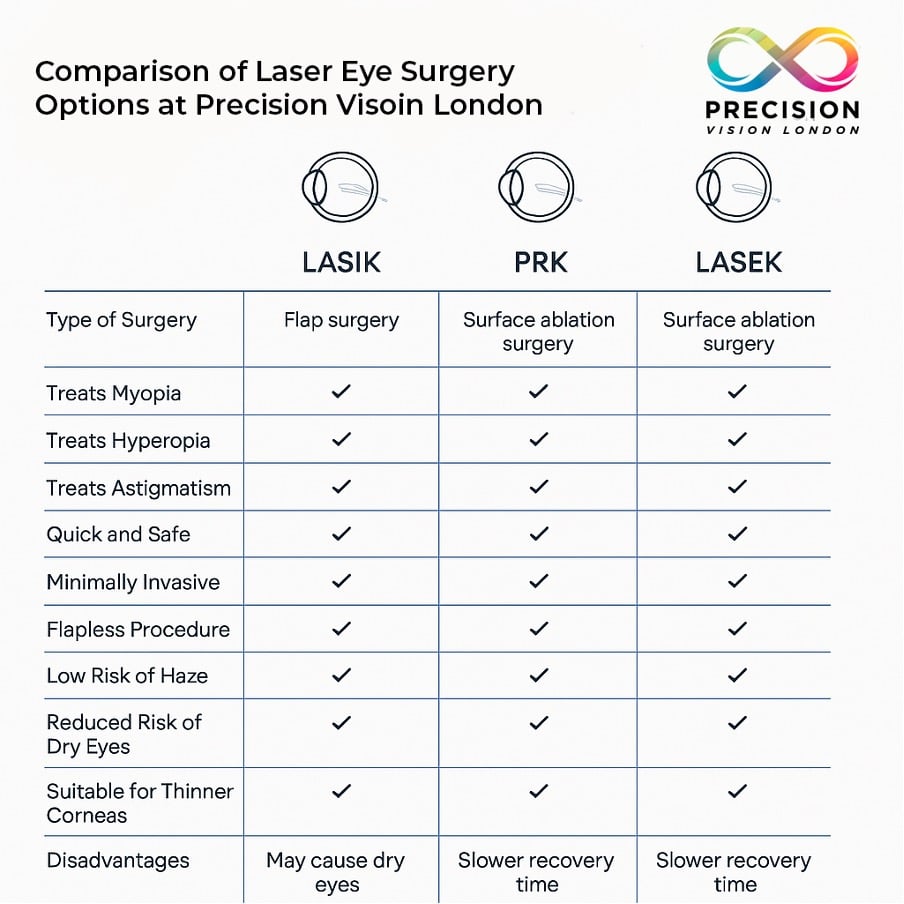
Which procedure suits you depends on your prescription, corneal thickness and lifestyle — a surgeon-led consultation determines suitability before anything is booked. Current prices for each option are on our pricing page.
What is not in the headline price
The biggest pricing surprises in laser eye surgery come from what the advertised figure leaves out. Whichever clinic you’re considering, check the quote against these seven common gaps:
1. Limited aftercare windows
Many high-street providers include only around three months of aftercare in the advertised price. After that, each optometrist visit can cost in the region of £100, and surgeon consultations around £200. A year of included follow-up is worth a meaningful amount — make sure you know where your cover ends.
2. Enhancement and retreatment charges
A small proportion of patients need a fine-tuning procedure to reach their target vision. At some clinics that enhancement is a separate — and substantial — bill. Ask directly: if I need a retreatment in the first year, what will it cost?
3. Premium technology upgrades
Wavefront-guided treatment, which maps and treats each eye individually, is sometimes sold as an upgrade costing up to £850 per eye. At clinics where it’s standard, that difference never appears on your bill — but you need to ask which category your quote falls into.
4. High prescription surcharges
The lowest advertised prices are usually based on minimal prescriptions. Stronger or more complex prescriptions — high myopia, significant astigmatism — can add hundreds of pounds at clinics that price by complexity, and this isn’t always made clear upfront.
5. Medications and eye drops
Your recovery depends on a course of antibiotic, anti-inflammatory and lubricating drops. Some clinics supply these within the price; others sell them separately.
6. Cancellation and booking fees
Read the small print before paying anything. Some providers retain up to £500 of a deposit depending on when you cancel, and others charge non-refundable booking fees simply to secure a consultation.
7. Insurance and complication cover add-ons
Optional extras such as complication cover can push the real price well past the advertised one. A genuinely all-inclusive price shouldn’t need them.
What a complete quote should include: your surgeon-led consultation and diagnostic scans, the procedure itself, all post-operative medications, every follow-up appointment through the first year, and any enhancement needed within that year. At Precision Vision London all of this is included in the price — see our pricing page for exactly what’s covered.
Is it worth the cost?
Set against a lifetime of corrective eyewear, a one-off procedure often compares better than people expect.
A typical pair of prescription glasses costs around £170, and most wearers replace them every two to three years as prescriptions change or frames wear out — before adding coatings, repairs and routine eye tests. Contact lenses cost more still: daily-disposable wearers commonly spend roughly £290 to £660 a year, plus solutions, cases and fitting appointments. Over twenty years, cumulative eyewear spending frequently reaches £6,000 to £10,000.
Laser eye surgery is a single upfront investment. Many patients find it pays for itself against contact lens costs within a decade, though the arithmetic depends on what you currently spend and which procedure you choose — and outcomes and costs vary from patient to patient. We’ve broken the numbers down year by year in our detailed guide: Is laser eye surgery worth it? The true cost vs glasses and contacts over 10 years.
Aftercare and recovery
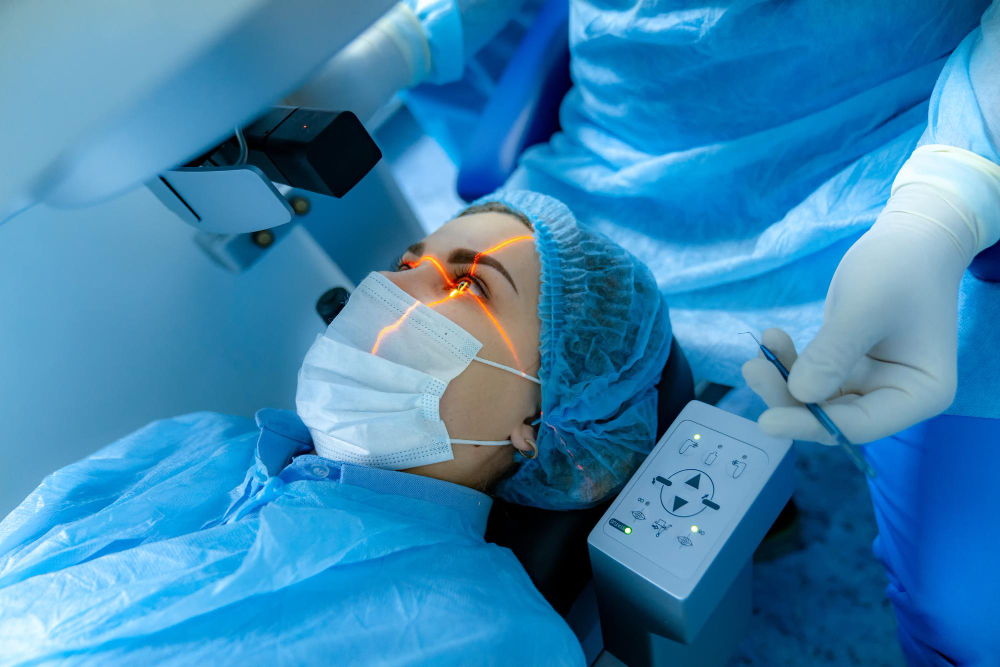
Recovery is quicker than most people expect, though it differs by procedure. Most LASIK patients can drive again within around 2–3 days and LASEK patients within around 4–5 days, once a follow-up confirms their vision meets the legal driving standard — individual healing varies. You’ll be seen within 24–48 hours of treatment for your first check.
For the first week, avoid dusty environments; swimming pools, saunas and hot tubs are off-limits for about four weeks, and contact sports for four to six weeks. Temporary dry eye is very common in the early months and typically improves over six to twelve months as the corneal nerves recover — lubricating drops help manage it. Also read: Why laser eye surgery dry eyes happen.
At Precision Vision London, your first year of follow-up appointments is included, with checks scheduled across the year to monitor healing, and the option to attend either our Harley Street clinic or a partner optometrist closer to home from three months onwards. A consultation is required to determine your suitability for treatment.
FAQs
Q1. How much does laser eye surgery cost in London? Most London clinics charge roughly £1,200 to £3,500 per eye depending on procedure and prescription. At Precision Vision London, treatment starts from £1,950 per eye, all-inclusive — the full price list is on our pricing page.
Q2. Is laser eye surgery available on the NHS? Generally not for vision correction. The NHS funds laser treatment only in exceptional circumstances, such as conditions that threaten sight. Elective correction of short-sight, long-sight or astigmatism is private treatment.
Q3. What hidden fees should I look out for? The most common are limited aftercare windows, separate enhancement charges, technology upgrades, high-prescription surcharges, medications sold separately, cancellation fees and optional cover add-ons. Ask any clinic for a written breakdown of exactly what the quote includes.
Q4. What should be included in the price? A complete package covers consultation and diagnostics, the procedure, post-operative medications, all first-year follow-ups and any enhancement needed within the first year.
Q5. How long is recovery? Most LASIK patients resume driving within 2–3 days and LASEK patients within 4–5 days; vision continues to stabilise over the following weeks. Your surgeon will confirm your individual timeline at your follow-ups.
Q6. Is laser eye surgery cheaper than glasses and contacts long term? Often, yes — contact lens wearers in particular can spend £6,000–£10,000 over twenty years, against a one-off procedure cost. See our 10-year cost comparison for the full arithmetic.